Off-Page
The Off-Page Authority Triangle: Reviews, PR, and Mentions
LLMs corroborate. Three off-page signals — reviews, PR, and unlinked mentions — form the triangle that decides whether an engine trusts your brand.

Clark Tota
Editor & Founder
Published April 30, 2026 · Updated May 16, 2026 · 9 min read
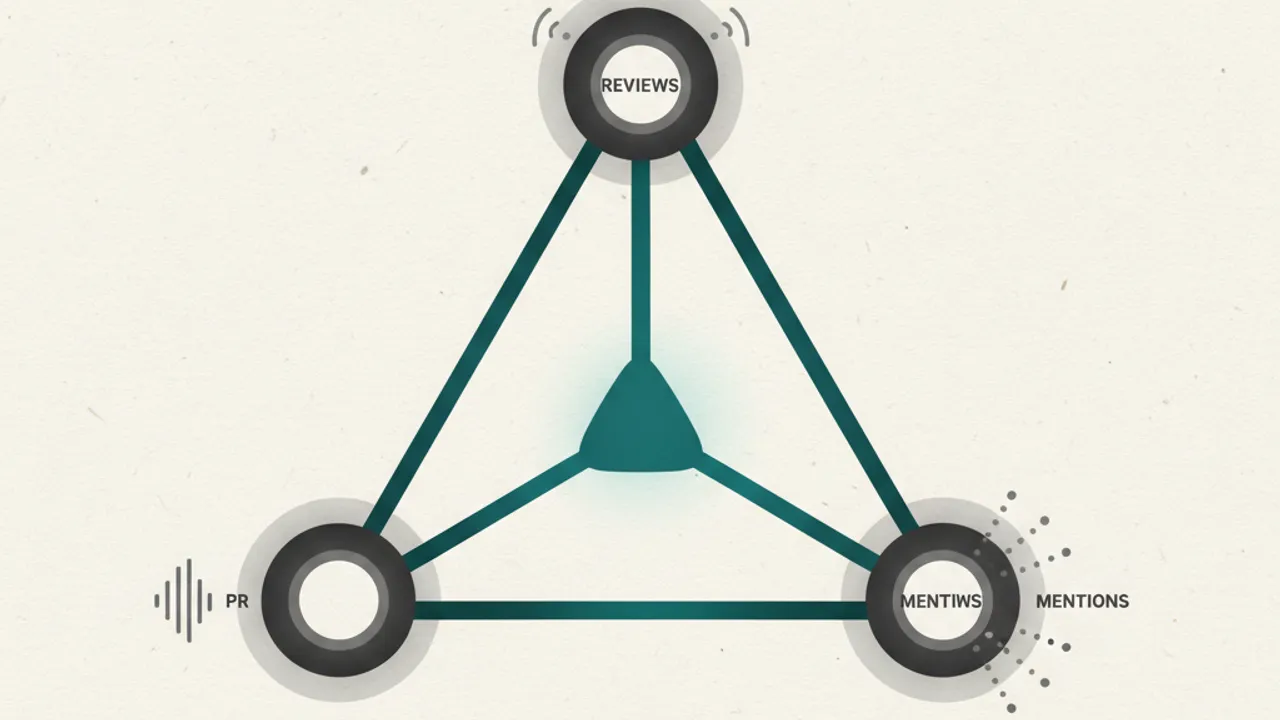
On-page work makes your content extractable. Off-page work makes the engine trust it. Three off-page signals form a triangle that, taken together, decides whether an answer engine treats your brand as a credible source: reviews, PR, and unlinked mentions.
Side one: Reviews
Review platforms — G2, industry-specific directories, Google — are corpora that answer engines read. A brand with consistent, substantive reviews on the platforms an engine trusts is corroborated as real and credible. Perplexity in particular leans on review sites.
Side two: PR
Press coverage in publications an engine already cites does two things: it provides a trusted third-party description of the brand, and it associates the brand with the topic in the model's view of the world. PR is not vanity here — it is entity corroboration.
Side three: Unlinked mentions and co-citation
Co-citation is being mentioned alongside a topic and alongside authoritative sources, even with no hyperlink. For LLMs this matters because training and retrieval build associations between entities from text proximity, not just links. A brand named in the same paragraph as the topic and a trusted source is being taught to the model.
Before
A client had solid PR and mentions but almost no reviews. Engines mentioned the brand but rarely as a recommended option.
After
After a focused review-generation push on two platforms, the brand started appearing in 'best of' style answers.
Takeaway
Engines were waiting for the third side of the triangle. Diagnose which side is missing before you spend.
How an agency operationalizes the triangle
- Audit all three sides for the client and score which is weakest.
- Invest first in the weakest side — that is where the marginal citation is cheapest.
- Re-measure citation share monthly and rebalance.
The Editor
Clark Tota
Clark Tota runs Answer Engine Weekly and a GEO/AEO consulting practice. He spends his weeks running prompt experiments against ChatGPT, Perplexity, Google AI Overviews and Claude — measuring which sources get cited and why — then writing up what actually moved the needle.
More about Answer Engine Weekly →The Weekly
One issue a week. A real experiment, the data, what it means.
One issue a week. A real AEO experiment, the raw data, and what it means for your agency. No fluff, no guru theatre.
No spam. Unsubscribe anytime. We send one email a week.
Keep reading

Do Exact-Match Domains Still Work? A Field Study in Entity Resolution from Danish Local Lead Generation
Exact-match domains were supposed to be dead. So why does a Copenhagen lead-gen SERP still reward them — and why does a domain spelled 'kobenhavn' rank for searches typed 'københavn'? A field study using live Semrush volumes, the real Copenhagen SERP, and one site's Search Console data shows what actually carries the boost in 2026: not the literal string, but the entity the engine resolves it to. The lesson generalises straight to answer engines.
May 31, 2026

The Agent Fleet Operating Manual: How a Small Team Runs a Business on AI Agents Without Drowning in Them
The operating discipline behind running a business on a fleet of AI agents: treat every manual action as a bug, build an agent-and-app pair only as a last resort, separate the expert-on-call agent from the always-on worker, gate expensive intelligence behind cheap heuristics, and delete as aggressively as you create. Includes the real incident — a 20-number outbound channel suspended overnight — that forced a dedicated risk agent into existence.
May 29, 2026

Building a Grounded Legal AI Assistant: A Worked Case Study in RAG, Hybrid Search, and EU Data Sovereignty
A documented build for the Italian legal vertical fattura-avvocato.it: the RAG architecture that kills hallucinations, the hybrid Postgres search that handles both 'Art. 1218 c.c.' and 'contractual liability for supplier breach', the monthly cost math against the €1,000/year incumbents, and the compliance constraints that disqualify a US-hosted model.
May 26, 2026